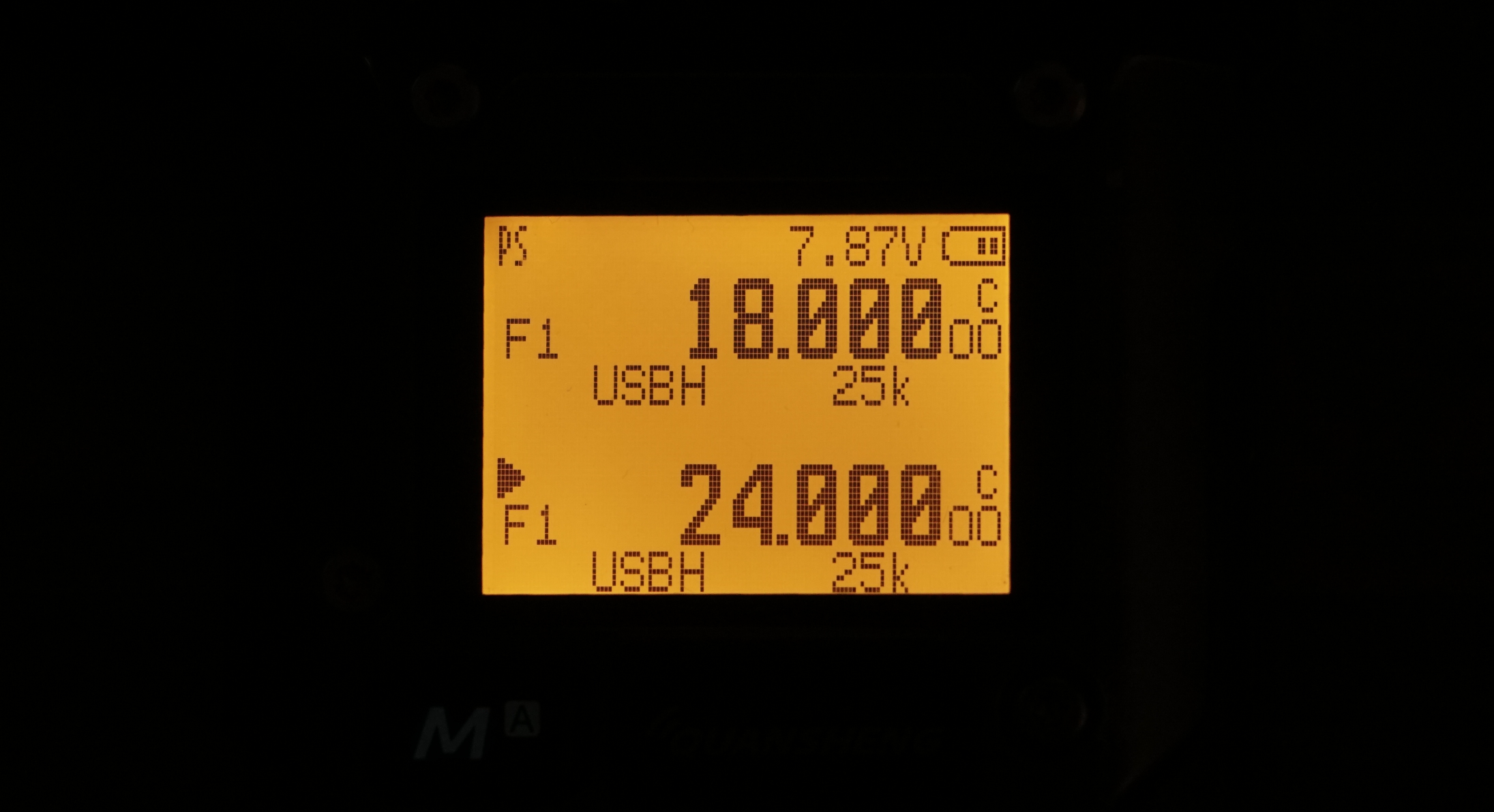
This post is meant to give you a straightforward introduction to HF radio and what actually makes it different and unique from everything else.
What is HF?
High frequency radio covers the range from 3 MHz to 30 MHz. That probably doesn’t mean much on its own, but what does matter is how signals behave in this range.
Unlike VHF or UHF, where your signal more or less travels in a straight line, HF signals can travel far beyond the horizon. This happens because they interact with the ionosphere, which is a layer of the atmosphere that can reflect radio waves back towards the ground.
In simple and very generalized terms, instead of your signal going out into space and disappearing, it goes up, bounces, and comes back down somewhere else. Sometimes very far away, depending on the conditions.
Why HF Feels Different
What makes HF interesting is that it’s not consistent.
You don’t just pick a frequency and expect it to work the same way all the time. Conditions change constantly, and a lot of that depends on things you can’t see.
Here are a few of the big ones:
-
Time of day
Lower frequencies tend to work better at night, higher ones during the day. You’ll notice this pretty quickly if you spend any time listening. -
Solar activity
The sun has a massive impact on HF. More activity usually means better long-distance propagation, but it can also cause interference. -
Band conditions
Sometimes a band is completely dead. Other times it’s full of signals from all over the world. There’s no switch you can flip to control it.
What You Can Do With HF
One of the main reasons people get into HF is for long-distance communication.
With the right setup, you can talk across countries or even continents without using repeaters or the internet. It’s just your radio, your antenna, and whatever the atmosphere is doing at that moment.
That said, it’s not perfect.
Signals fade in and out. Noise can be a problem. You might hear someone clearly one minute and lose them the next. That’s just part of how HF works.
Antennas Matter (A Lot)
Another thing you’ll run into pretty quickly is that antennas matter more than you expect.
At these frequencies, antennas are physically larger, and small changes can make a big difference. A simple wire antenna (like a dipole) set up properly can outperform something much more expensive, which gives people with DIY gear more leverage.
It’s one of those areas where experimentation really pays off and a lot of people get into radio just for the fun of antenna-making.
HF Bands
HF is split into different bands, and each one behaves a bit differently. Some are better for shorter distances, others are known for long-range contacts. Learning which band to use and when is something that comes with time.
Here's a list of some popular bands:
80 metres: 3.500 – 3.800MHz
60 metres: 5.000 – 5.400Mhz
40 metres: 7.000 – 7.300MHz
30 metres: 10.100 – 10.150MHz
20 metres: 14.000 – 14.350MHz
17 metres: 18.068 – 18.168MHz
15 metres: 21.000 – 21.450MHz
12 metres: 24.890 – 24.990MHz
10 metres: 28.000 – 29.700MHz
Getting Started
If you’re thinking about getting into HF, the basic requirements are pretty simple:
- A radio that's capable of receiving and/or transmitting in the HF range.
- An antenna. This part is more important than the radio. You should spend a lot of time choosing or making an antenna as that will be the element of your setup that will be crucial to your experience.
After that, it’s mostly about getting on the air and figuring things out as you go.
HF radio isn’t as predictable as some other parts of the hobby, and that’s exactly why people enjoy it. You’re not just using equipment, you’re working with conditions that change from hour to hour.
Sometimes nothing is happening at all. Then suddenly a band opens up and you’re hearing stations from places you didn’t expect.
That’s the part that keeps people coming back.